


 TR
 EN
 RU
 AR
 FR


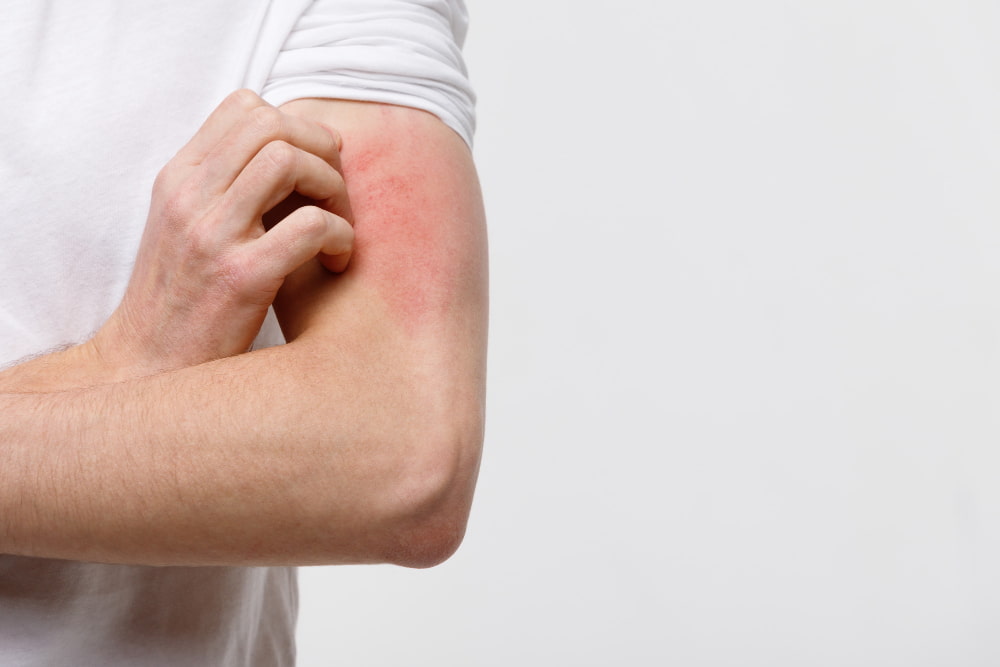

Scabies is a contagious skin infestation caused by a microscopic mite. It commonly causes intense itching and a rash, often becoming worse at night. Although scabies can be uncomfortable and spread easily through close contact, effective treatment is available.
Understanding what scabies looks like, how it spreads, and how to treat close contacts and household items can help stop reinfection. This guide explains scabies symptoms, scabies treatment, types of scabies, and practical steps for managing a scabies infection.
What Is Scabies?
Scabies is a skin condition caused by Sarcoptes scabiei var. hominis, also called the human itch mite. This tiny ectoparasitic mite burrows into the top layer of human skin, where it lays eggs and triggers an immune reaction.
The immune response causes the main clinical features of scabies: itching, inflammation, and a scabies rash. The mites are too small to see without magnification. Scabies is not caused by poor hygiene, and anyone can develop it.
A scabies infection mainly spreads through prolonged, close skin-to-skin contact. It can affect people of any age, including babies, children, adults, and older people.
Where Do Scabies Come From?
Scabies comes from direct contact with a person who has the infestation. A person can spread mites before they realise they have scabies, particularly when symptoms are mild or have not yet developed.
How is scabies transmitted? The most common route is prolonged, close skin contact, such as:
Living in the same household
Sharing a bed
Sexual contact
Caring for someone who needs close physical assistance
Close contact in childcare settings, nursing homes, hospitals, or other group settings
Scabies can occasionally spread through recently used bedding, towels, clothing, or soft furnishings, especially with crusted scabies. However, ordinary brief contact, such as a handshake or sitting near someone, is less likely to spread classic scabies.
How to Identify Scabies
How to identify scabies can be difficult because the rash may resemble eczema, insect bites, contact dermatitis, or other skin conditions. Scabies at the beginning may cause only mild itching, small bumps, or a few scratch marks.
A typical scabies rash includes small red, skin-colored, or darker raised bumps. In some people, thin, wavy, grayish, white, or skin-colored lines may be visible. These lines are called scabies burrows and can indicate where the female mite has moved under the skin.
Common areas for classic scabies include:
Between the fingers
Around the wrists
Elbows and armpits
Around the waist, buttocks, or lower abdomen
Groin and genital area
Around the nipples
Ankles and feet
In adults, scabies on the face and scalp is uncommon. In babies, young children, older adults, and people with weakened immune systems, however, the scalp, face, neck, palms, and soles may also be affected.
Pictures of scabies rash found online can be useful for general awareness, but they cannot confirm a diagnosis. Skin tone, age, scratching, and secondary infection can change the appearance of the rash. A healthcare professional should assess an unexplained itchy rash, especially when several people in the same home are itching.
Scabies Symptoms
The most common symptom of scabies is severe itching, often worse at night or after a warm bath. The itching is caused mainly by the body’s reaction to mites, eggs, and mite waste rather than by the mite itself.
Common scabies symptoms include:
Intense itching, particularly at night
A red, bumpy, or irritated scabies rash
Small blisters, pimples, or crusted areas
Scabies burrows, which may look like short, wavy lines
Scratch marks and sores caused by repeated itching
Thickened skin or nodules in some cases
“Scabies bites” is a commonly used search term, but scabies does not cause bites in the same way as mosquitoes, fleas, or bed bugs. The rash develops because mites burrow into the skin and cause an inflammatory reaction.
Symptoms may take several weeks to appear after a first infestation. This delay means a person may unknowingly pass scabies to close contacts. If a person has had scabies before, itching and rash may develop more quickly after re-exposure.
Types of Scabies
There are several types of scabies. The appearance and severity can differ depending on the immune response, age, overall health, and number of mites present.
Classic Scabies
Classic scabies is the most common form. It usually causes widespread itching, a papular rash, and sometimes visible burrows. The number of mites is generally low, but itching can be severe.
Nodular Scabies
Nodular scabies causes persistent, itchy reddish-brown or skin-colored nodules, often in the groin, genital area, buttocks, or armpits. These nodules may remain for weeks or months after successful treatment because they result from a continuing inflammatory response.
Crusted Scabies
Crusted scabies, also called Norwegian scabies, is a severe form in which the skin develops thick, scaly, crusted patches. It may contain very large numbers of mites and is highly contagious.
Crusted scabies is more likely in people with a weakened immune system, neurological conditions, limited mobility, or difficulty noticing or scratching itchy skin. It requires prompt medical care and may need combined topical and oral treatment.
Distinguishing Scabies from Similar Skin Conditions
Several conditions can cause itching and a rash similar to scabies. These include lice, bed bugs, eczema, contact dermatitis, hives, and psoriasis. Because each requires different treatment, a healthcare professional should confirm the diagnosis.
Scabies vs. Lice
Lice live on the scalp, body hair, pubic hair, or clothing. Live lice or their eggs, called nits, may be visible. Scabies mites are too small to see easily and burrow into the skin.
Scabies commonly causes severe night-time itching, burrows, and a rash between the fingers, around the wrists, waist, groin, or buttocks. Lice treatments do not treat scabies.
Scabies vs. Flea Bites
Flea bites are usually small, red, itchy bumps that appear in clusters or short lines. They most often affect the ankles, lower legs, feet, or other areas where fleas can reach the skin. Fleas are commonly found on pets, carpets, bedding, and upholstered furniture.
Unlike scabies mites, fleas do not burrow into the skin. Flea bites may appear soon after exposure to an infested pet or environment, while scabies usually causes persistent itching—often worse at night—along with bumps or burrows in areas such as the finger webs, wrists, waist, groin, and buttocks.
Scabies vs. Bed Bugs
Bed bugs live in mattresses, furniture, and cracks near sleeping areas. Their bites often appear in clusters or lines on exposed skin, such as the arms, neck, face, or legs.
Scabies mites live in the skin and commonly affect the finger webs, wrists, waist, groin, and skin folds. Household insecticides should never be applied to the skin.
Scabies vs. Eczema
Eczema can cause itchy, dry, red, cracked, or scaly skin and often follows a recurring pattern. It commonly affects the face, hands, or folds of the elbows and knees.
Scabies is more likely when itching begins suddenly, becomes worse at night, affects typical scabies sites, or occurs in several household members. Burrows are also more suggestive of scabies than eczema.
Scabies vs. Contact Dermatitis
Contact dermatitis develops after exposure to an irritant or allergen, such as soap, detergent, cosmetics, fragrances, or metals. The rash usually appears where the substance touched the skin and may improve when exposure stops.
Scabies is more likely when the rash spreads beyond the contact area, causes intense night-time itching, or affects close contacts.
Scabies vs. Hives
Hives, or urticaria, cause raised, itchy welts that can appear suddenly and change shape or location. Individual hives often fade within 24 hours, although new ones may develop elsewhere. Triggers can include infections, medicines, foods, insect exposure, heat, pressure, or other factors.
Scabies lesions usually persist in the same areas and may include small bumps, blisters, scratch marks, or burrows. Scabies itching commonly continues for weeks without treatment and is often worse at night.
Swelling of the lips, tongue, throat, or face, or difficulty breathing with hives, requires urgent medical attention.
Scabies vs. Psoriasis
Psoriasis is a chronic immune-mediated condition that commonly causes well-defined, thickened plaques covered with silvery or white scale. It often affects the elbows, knees, scalp, lower back, or nails, although it can occur elsewhere.
Scabies can cause scaly or crusted areas after prolonged scratching. Crusted scabies may be particularly difficult to distinguish from psoriasis or severe eczema because it causes thick, widespread crusts. In people with extensive crusting, weakened immunity, or a rash that does not respond as expected, prompt medical evaluation is important.
Scabies vs. Folliculitis
Folliculitis is inflammation or infection around hair follicles. It may cause small red bumps, pimples, pustules, tenderness, or burning, particularly in areas exposed to friction, shaving, sweating, or occlusive clothing.
Unlike scabies, folliculitis is centred around hair follicles and does not typically cause burrows or intense night-time itching. However, scratching caused by scabies can damage the skin and lead to a secondary bacterial infection that resembles folliculitis.
Risk Factors for Scabies
Risk factors for scabies are mainly related to close contact and living circumstances rather than personal cleanliness. The condition may spread more easily in crowded settings or where people share beds, clothing, towels, or care support.
Risk factors include:
Living with or having close contact with someone who has scabies.
Sexual contact with an affected person.
Residence in crowded or institutional settings.
Living in a nursing home, hospital, prison, shelter, or childcare facility.
Having a weakened immune system.
Being an older adult or having reduced mobility.
Having crusted scabies in the household or care environment.
Anyone can get scabies. Prompt treatment of the affected person and close contacts is essential to prevent ongoing spread.
Diagnosing Scabies
A healthcare professional can often diagnose scabies by examining the skin, asking about itching and close contacts, and identifying the typical pattern of rash or burrows.
If the diagnosis is uncertain, the clinician may use a dermatoscope, a handheld device that magnifies the skin. In some cases, a small skin scraping may be examined under a microscope to look for mites, eggs, or mite material.
A negative skin scraping does not always rule out scabies because there may be very few mites in classic scabies. Diagnosis is often based on the overall pattern of symptoms, rash distribution, and whether other close contacts have similar itching.
Scabies Treatment
Scabies treatment requires medicine that kills mites. Home remedies for scabies, such as essential oils, vinegar, bleach, disinfectant sprays, or household insecticides, are not proven treatments and may irritate or burn the skin.
Most people need a prescription lotion or cream for scabies. Permethrin cream is often a first-choice treatment. It is usually applied to clean, dry skin over the body as directed by a healthcare professional and then washed off after the recommended time.
For many adults, treatment is applied from the neck down, including the spaces between fingers and toes, under nails, the groin, buttocks, and soles of the feet. In babies, young children, older adults, and some other groups, the face, scalp, neck, and ears may also need treatment. Follow individual medical instructions carefully.
A second application is often recommended about one week later to treat newly hatched mites. Hands may need treatment again after washing during the application period.
Ivermectin is an oral prescription medicine. It may be used for crusted scabies, outbreaks, treatment that has not worked with topical medicine, or when a person cannot use topical treatment effectively. It is not appropriate for everyone, including some pregnant people and young children, so a clinician should determine whether it is safe.
Other prescription options may include benzyl benzoate, sulfur ointment, crotamiton, or other topical treatments depending on local availability, age, pregnancy status, and medical history.
Over-the-counter remedies for scabies do not kill mites. Products such as calamine lotion, antihistamines, cool compresses, and mild topical anti-itch treatments may help relieve itching after medical treatment has begun, but they do not replace scabies medicine.
Treating Household Contacts and Clothing
Everyone in the household and other close physical contacts should usually be treated at the same time, even if they do not yet have symptoms. This is important because symptoms can take weeks to develop.
On the day treatment begins:
Wash recently used clothing, bedding, towels, and pajamas in hot water.
Dry items using a hot dryer cycle when possible.
Dry-clean items that cannot be washed.
Seal unwashable items in a plastic bag for at least 72 hours.
Vacuum carpets, upholstered furniture, and mattresses, especially if crusted scabies is present.
Wear clean clothing and use clean bedding after treatment.
Extensive use of insecticide sprays in the home is generally unnecessary for classic scabies and should not be applied to skin.
Managing Itching After Treatment
Itching may continue for several weeks after effective scabies treatment. This does not automatically mean the treatment has failed, because the skin can remain irritated while the immune reaction settles.
Scabies relief may include cool baths, fragrance-free moisturizers, calamine lotion, antihistamines, or a topical anti-inflammatory medicine when recommended by a clinician. Avoid scratching as much as possible because broken skin can lead to bacterial infection.
Contact a healthcare professional if new burrows or new bumps continue to appear after treatment, if itching remains severe beyond several weeks, or if close contacts develop symptoms. Treatment failure may result from incorrect application, untreated contacts, reinfection, or another skin condition.
Complications of Scabies
Repeated scratching can break the skin and lead to a bacterial skin infection. Warning signs include increasing redness, warmth, swelling, pain, pus, crusting, fever, or rapidly spreading sores.
In severe cases, bacterial infection associated with scabies can lead to more serious health problems. Children and people with crusted scabies may be at greater risk. Prompt assessment is important if the rash appears infected or a person becomes unwell.
When to Seek a Professional Diagnosis
Seek medical advice when itching is intense, persistent, worse at night, affecting several household members, or accompanied by a rash in the hands, wrists, waist, groin, or skin folds. Professional assessment is especially important for infants, older adults, pregnant people, people with weakened immune systems, and anyone with crusted skin or signs of infection.
Because scabies can resemble eczema, contact dermatitis, psoriasis, hives, folliculitis, lice, and bed bug bites, treatment should be based on a clinical assessment rather than on photographs or over-the-counter trial and error. A dermatologist can examine the skin, review relevant contact history, and recommend appropriate testing or treatment when necessary.




 Makaleye Dön
 E-Result
 WhatsApp