


 TR
 EN
 RU
 AR
 FR


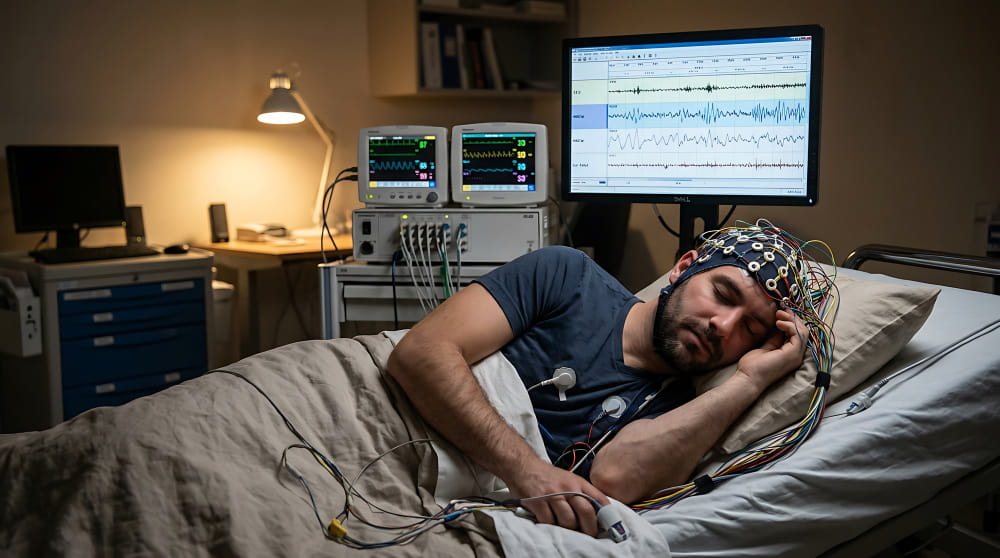

A sleep study, or polysomnography (PSG), is an overnight diagnostic test that records the body's activity during sleep. It monitors brain waves, sleep stages, eye movements, muscle activity, breathing, oxygen levels, heart rhythm, and body movements to provide a detailed picture of how a person sleeps. Polysomnography is used to investigate a range of sleep disorders, particularly when symptoms cannot be explained by a simple clinical assessment alone.
An in-lab polysomnography is the most comprehensive form of a sleep study. Unlike a test that only monitors breathing, PSG can determine when a person is actually asleep and identify different stages of sleep. This makes it useful for evaluating sleep apnea as well as conditions such as narcolepsy, parasomnias, periodic limb movements, and unexplained excessive daytime sleepiness.
What Is a Sleep Study?
A sleep study is a monitored evaluation performed while a person sleeps. During an in-lab polysomnographic sleep study, a sleep technologist attaches several sensors to the patient's scalp and body to continuously record physiological signals throughout the night.
One of the defining features of PSG is the recording of brain activity with electroencephalography (EEG). EEG signals allow the sleep team to distinguish wakefulness from sleep and identify different sleep stages, including REM sleep. Other sensors provide information about breathing, oxygenation, heart activity, muscle tone, eye movements, and body movement.
A comprehensive sleep study can therefore show:
How quickly a person falls asleep
How long they remain asleep
How much time they spend in each sleep stage
Brain waves during sleep
REM sleep and eye movements
Breathing patterns and airflow
Oxygen saturation during sleep
Heart rate and rhythm
Muscle activity
Limb movements
Body position
Brief awakenings or arousals
Unusual movements or behaviors during sleep
Because these measurements are recorded simultaneously, a sleep specialist can assess whether abnormal events occur during a particular stage of sleep or are associated with changes in breathing, oxygen levels, muscle activity, or heart rhythm.
What Does Polysomnography Measure?
Polysomnography combines several physiological measurements to evaluate sleep from multiple perspectives. The individual signals are interpreted together rather than as isolated findings.
Brain Waves and Sleep Stages
EEG electrodes placed on the scalp record electrical activity in the brain. These recordings allow the sleep specialist to identify when the patient is awake and when they enter different stages of non-REM and REM sleep.
The distribution of these stages is known as sleep architecture. Changes in sleep architecture can be relevant when evaluating excessive daytime sleepiness, disrupted sleep, unusual nighttime events, and certain neurological or sleep disorders.
Eye and Muscle Movements
Electrooculography (EOG) records eye movements and helps identify REM sleep. Electromyography (EMG) records muscle activity, including activity in the chin and legs.
These measurements can help identify abnormal muscle activity, periodic limb movements, and unusual behaviors that occur during sleep. They may also help the sleep specialist determine which sleep stage an event occurred in.
Breathing and Oxygen Saturation
Sensors measure airflow through the nose and mouth, while additional bands measure respiratory effort from movements of the chest and abdomen. A sensor, usually placed on the finger, continuously monitors blood oxygen levels.
These measurements can reveal changes in breathing and oxygen saturation during sleep. They are particularly important when evaluating sleep-related breathing disorders, including obstructive and central sleep apnea.
Heart Rhythm and Body Movement
An EKG records heart rate and electrical activity throughout the night. Additional sensors can record body position and significant movements.
The combination of these signals can help determine whether changes in heart rate, body position, or movement are associated with particular sleep events.
How Does a Sleep Study Work?
An in-lab sleep study usually takes place overnight in a dedicated sleep laboratory or hospital. The patient arrives in the evening, meets the sleep technologist, and is prepared for the recording before going to sleep.
The sensors are connected to a recording system but are designed to allow normal movement during sleep. The technologist monitors the signals remotely throughout the night and can make technical adjustments if necessary.
Knowing how does a sleep study work can make the procedure feel less unfamiliar. Although the equipment may initially seem extensive, the sensors are generally lightweight, and patients can move, change sleeping positions, and get up when necessary.
What Happens During the Night?
The overnight process generally involves:
Arriving at the sleep center in the evening and changing into comfortable sleepwear
Having the scalp and body sensors applied by a trained technologist
Checking each signal before the recording begins
Following a normal bedtime routine as much as possible
Sleeping while the equipment continuously records physiological activity
Being monitored remotely by the sleep technologist
Having the sensors removed in the morning
A typical overnight study involves approximately 6–8 hours of recorded sleep, although the exact duration can vary. The patient does not need to sleep exactly as they would at home for the test to be useful.
Can You Sleep During a Sleep Study?
Yes. Sleeping is the purpose of an overnight polysomnography. The sleep room is arranged to provide a comfortable environment, and the sensors are designed to allow the patient to move naturally.
It is common to feel that sleep was lighter or shorter than usual because the environment is unfamiliar. However, patients often sleep more than they realize, and the recorded signals allow the sleep team to determine actual periods of sleep.
What Can a Sleep Study Diagnose?
What can a sleep study diagnose depends on the patient's symptoms and the reason the test was ordered. Because an in-lab PSG records both brain activity and multiple physiological functions, it can contribute to the evaluation of a broad range of sleep disorders.
Sleep Apnea
A sleep study for sleep apnea can identify repeated interruptions or reductions in breathing during sleep. It can help distinguish obstructive sleep apnea, in which the upper airway becomes narrowed or blocked, from central sleep apnea, which involves a reduction or interruption in the signals that regulate breathing.
The study can assess:
The frequency and duration of breathing events
Changes in oxygen saturation
Whether events vary according to sleep stage
Whether events are more common in particular sleeping positions
Arousals associated with breathing disturbances
The findings can help determine whether treatment for sleep-disordered breathing is appropriate and what type of treatment may be considered.
Polysomnography for Narcolepsy
Polysomnography for narcolepsy follows a specific diagnostic protocol. An overnight in-lab PSG is generally performed first, followed by a Multiple Sleep Latency Test (MSLT) during the following day.
The overnight PSG documents the patient's sleep and helps identify other conditions that could contribute to excessive daytime sleepiness. The MSLT then measures how quickly the patient falls asleep during several scheduled daytime nap opportunities and assesses whether REM sleep occurs unusually soon after sleep onset.
This combination is important because narcolepsy cannot be diagnosed simply by observing whether someone is sleepy during the day. The PSG and MSLT findings are interpreted together with symptoms and medical history.
In some circumstances, a Maintenance of Wakefulness Test (MWT) may also be used to assess a person's ability to remain awake under conditions designed to encourage quiet wakefulness. The MWT answers a different clinical question from the MSLT and is not a substitute for the diagnostic role of the MSLT in narcolepsy.
Parasomnias
Parasomnias are unusual behaviors, movements, or experiences that occur during sleep. Examples may include complex movements, vocalizations, or other abnormal behaviors that are difficult to characterize from a patient's description alone.
A sleep study for parasomnia can record brain activity, muscle activity, body movement, and sleep stage at the time an event occurs. Video monitoring may also be used when appropriate.
These recordings can help the sleep specialist determine whether an event is associated with a particular stage of sleep and whether additional neurological or sleep evaluation is necessary.
Limb Movements and Restless Legs-Related Sleep Disruption
Polysomnography can identify repetitive limb movements during sleep and determine whether they are associated with arousals or fragmented sleep.
Restless legs syndrome is generally diagnosed based on symptoms rather than PSG findings. However, a sleep study for restless legs syndrome may be considered when the clinician needs to evaluate periodic limb movements during sleep or determine whether another sleep disorder is contributing to disrupted sleep.
Other Sleep-Related Disturbances
Depending on the clinical situation, PSG may also contribute to the evaluation of:
Unexplained excessive daytime sleepiness
Sleep-related movement disorders
Seizure-related sleep disturbances
Abnormal muscle activity during sleep
Complex nighttime events
Sleep disorders involving abnormal sleep architecture
Additional tests may be necessary when PSG alone cannot establish the cause of a patient's symptoms.
Sleep Study for Insomnia
A sleep study for insomnia is not routinely necessary when a person has uncomplicated insomnia. Insomnia is usually diagnosed clinically by evaluating difficulty falling asleep or staying asleep, early morning awakening, daytime effects, sleep habits, medications, medical history, and other contributing factors.
Polysomnography may be considered when insomnia occurs alongside symptoms suggesting another sleep disorder. For example, a patient with persistent sleep difficulties who also has loud snoring, witnessed breathing pauses, unusual nighttime behaviors, significant limb movements, or unexplained daytime sleepiness may require an overnight study.
In these situations, PSG is being used to investigate a possible underlying sleep disorder rather than simply to confirm insomnia.
For persistent insomnia without signs of another sleep disorder, treatment generally focuses on behavioral and psychological approaches rather than an overnight sleep study. Cognitive behavioral therapy, particularly cognitive behavioral therapy for insomnia (CBT-I), is commonly used to address unhelpful sleep-related thoughts and behaviors and improve sleep patterns.
When Is a Sleep Study Necessary?
A sleep specialist may recommend an in-lab sleep study when the patient's symptoms suggest that detailed monitoring of sleep is necessary. The decision is based on the clinical picture rather than on one symptom alone.
Signs you need a sleep study may include:
Persistent excessive daytime sleepiness
Difficulty staying awake during routine daytime activities
Loud or persistent snoring
Witnessed pauses in breathing or nighttime gasping
Repeated unexplained awakenings
Unusual movements or behaviors during sleep
Recurrent limb movements
Symptoms suggesting narcolepsy
Suspected central sleep apnea
Unexplained nighttime events
Sleep symptoms that remain unresolved after an initial evaluation
Not every person with these symptoms requires polysomnography. A sleep specialist determines whether PSG, another type of sleep test, or clinical evaluation is most appropriate.
Nasal and ear-related problems can also contribute to disrupted sleep. For example, a deviated septum can restrict nasal airflow and may be associated with snoring or other nighttime breathing difficulties, while tinnitus may make it harder to fall asleep or stay asleep because of persistent ringing or other sounds in the ears.
What About a Home Sleep Apnea Test?
A home sleep apnea test is a more limited test used in selected patients when obstructive sleep apnea is suspected. It generally records breathing-related signals and oxygen levels but does not record brain waves or directly determine sleep stages.
For this reason, a home sleep apnea test cannot provide the same information as an in-lab PSG. When a patient needs evaluation for narcolepsy, parasomnia, unexplained excessive daytime sleepiness, suspected central sleep apnea, or another complex sleep disorder, comprehensive polysomnography may be required.
How to Prepare for a Sleep Study
Preparation for an overnight polysomnography is generally straightforward. The sleep center provides individual instructions, but patients are usually encouraged to maintain their usual sleep schedule and arrive ready to spend the night at the facility.
Before the study, patients may be advised to:
Follow their usual sleep and wake schedule.
Avoid alcohol because it can affect sleep patterns and some sleep-related measurements.
Limit caffeine according to the sleep center's instructions.
Take medications as directed by the healthcare team.
Avoid hair products, heavy lotions, or oils that could interfere with sensor placement.
Bring comfortable sleepwear and personal toiletries.
Bring glasses, contact lens supplies, or other usual bedtime items.
Bring previous sleep study results and relevant medical records when requested.
Patients should not stop prescription or other medications on their own before a sleep test. Any medication changes should be discussed with the healthcare team in advance.
Understanding Your Sleep Study Results
Sleep study results contain multiple measurements describing sleep, breathing, oxygenation, movements, and other physiological activity. A sleep physician reviews the complete recording and interprets the findings according to the patient's symptoms and the reason the test was performed.
Sleep Architecture and Sleep Stages
Because PSG records EEG, it can determine when the patient is awake and asleep and identify different stages of non-REM and REM sleep.
The report may include:
Total sleep time
Sleep efficiency
Sleep latency
REM latency
Time spent in individual sleep stages
Number of awakenings and arousals
Distribution of REM and non-REM sleep
These findings help the sleep specialist determine whether sleep architecture is significantly disrupted and whether abnormalities occur during particular stages.
The Apnea-Hypopnea Index (AHI)
When sleep-disordered breathing is being assessed, the apnea-hypopnea index (AHI) is an important measurement. It represents the average number of apneas and hypopneas occurring per hour of sleep.
An apnea is a complete or near-complete interruption of airflow, while a hypopnea is a significant reduction in airflow. In adults, AHI is commonly categorized as:
Less than 5 events per hour: generally not considered diagnostic of obstructive sleep apnea on its own
5 to less than 15 events per hour: mild sleep apnea
15 to less than 30 events per hour: moderate sleep apnea
30 or more events per hour: severe sleep apnea
The AHI score meaning should always be considered alongside the rest of the sleep study results. Oxygen saturation, symptoms, sleep position, sleep stage, event duration, and other findings can also be clinically important.
AHI is specifically relevant to sleep-disordered breathing; it does not represent overall sleep quality or summarize every aspect of a polysomnography.
Other Sleep Study Results
Depending on the reason for testing, the report may also describe:
Oxygen saturation and oxygen desaturation events
Heart rate and rhythm
Limb movement frequency
Arousal index
Sleep efficiency
REM and non-REM sleep distribution
Body position
Respiratory events
Abnormal muscle activity
The sleep specialist considers these findings together rather than using one measurement to establish a diagnosis.
What Happens After a Sleep Study?
After the overnight recording, the collected data are scored and reviewed by a sleep physician. The results are then discussed with the patient, including any abnormalities identified and whether they explain the symptoms that led to testing.
Depending on the findings, the next steps may include:
Treatment for an identified sleep disorder
CPAP or another positive airway pressure treatment when indicated
An oral appliance for selected patients with sleep-disordered breathing
Further neurological or sleep testing
An MSLT when narcolepsy or another cause of excessive daytime sleepiness requires evaluation
Additional assessment of nighttime movements or behaviors
Evaluation of contributing upper-airway or other medical factors
Follow-up monitoring after treatment begins
How long to get sleep study results varies depending on the complexity of the recording, the scoring process, and physician review. The sleep center can provide information about the expected timing of the report and follow-up consultation.
Sleep Studies in Turkey
For international patients, a sleep study in Turkey can be arranged following a specialist evaluation of sleep-related symptoms. Previous medical records, medication information, and earlier sleep test results can be reviewed before the appropriate diagnostic approach is selected.
When an in-lab PSG is indicated, the process includes specialist consultation, preparation for the overnight study, sensor placement, overnight monitoring, analysis of the recorded signals, and physician review of the results. Patients undergoing evaluation for narcolepsy may require an MSLT on the following day, making coordination of the overnight and daytime assessments particularly important.
Patients considering polysomnography in Turkey may also wish to ask about the sleep laboratory's equipment, monitoring capabilities, and accreditation. Sleep study cost and insurance coverage can vary depending on the type of test, the facility, and the patient's coverage, so these details should be confirmed before scheduling.
For international patients, coordinating consultation, testing, results review, and follow-up within the same healthcare system can make the diagnostic process more practical when travel is involved.
Why Choose Medical Park for the Diagnosis and Treatment of Sleep Disorders?
Medical Park Hospitals in Turkey provide evaluation and treatment for patients experiencing ongoing sleep problems and suspected sleep disorders. Depending on the patient's symptoms and clinical needs, the evaluation may involve Neurology specialists together with specialists from other relevant disciplines, such as Chest Diseases (Pulmonology), Ear, Nose and Throat (ENT), Psychiatry, or other fields. Working across specialties when appropriate can help identify factors contributing to sleep problems and guide the patient's diagnostic and treatment plan.
When an overnight polysomnography is indicated, the study records brain activity, sleep stages, eye and muscle movements, breathing, oxygen levels, heart rhythm, body position, and other changes that occur during sleep. The findings can be considered alongside the patient's symptoms and other clinical assessments to help identify conditions such as sleep apnea, narcolepsy, parasomnias, movement-related sleep disturbances, excessive daytime sleepiness, and other sleep disorders.


 Makaleye Dön
 E-Result
 WhatsApp