


 TR
 EN
 RU
 AR
 FR


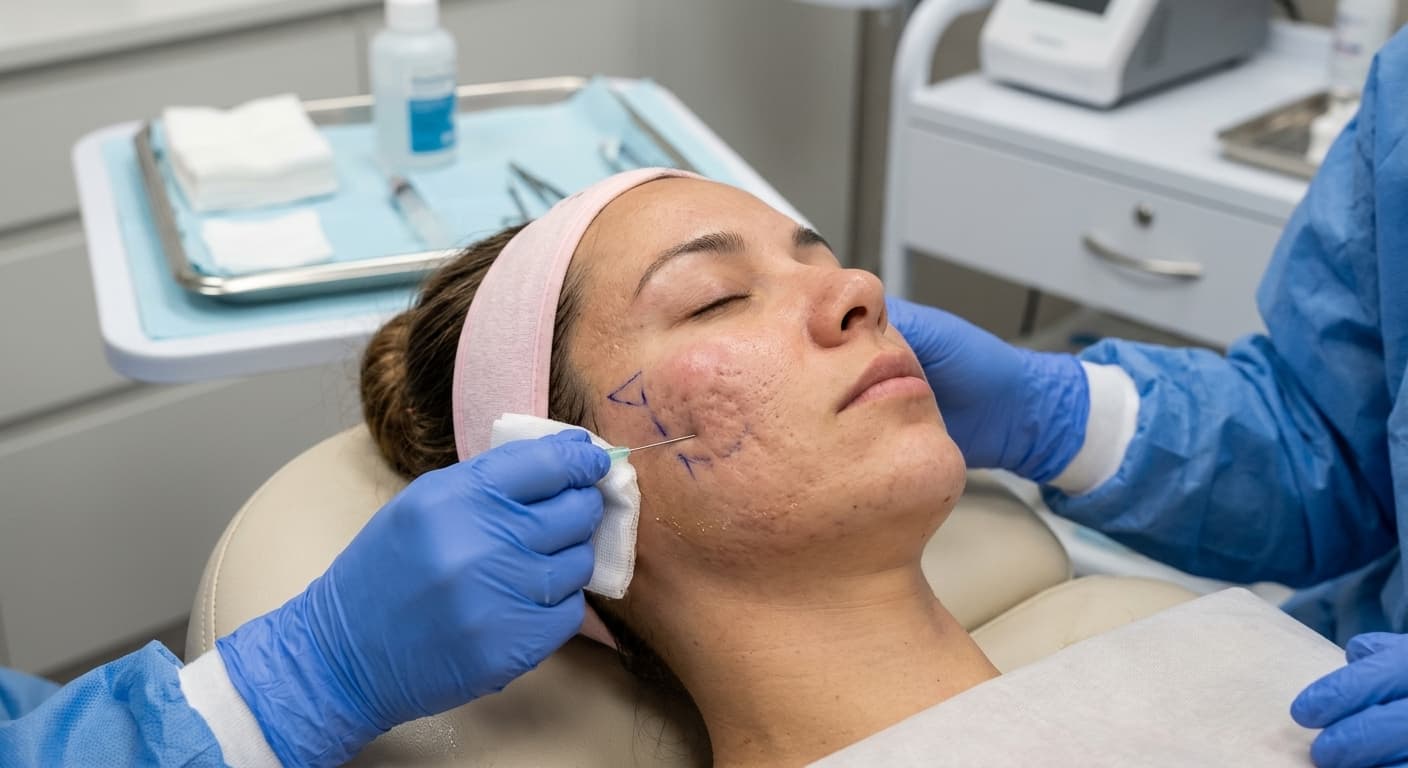

Subcision is a minimally invasive procedure that releases the bands of tissue pulling the skin downward in certain depressed scars and cellulite dimples. A doctor inserts a fine needle or specialized instrument beneath the skin to loosen these attachments, allowing the surface to lift and encouraging new supportive tissue to form.
The procedure is usually performed under local anesthesia and is most suitable for rolling acne scars, selected tethered scars, and isolated cellulite dimples. Results develop over weeks to months, and more than one session may be needed. Bruising, swelling, tenderness, and temporary firmness are common during recovery. Subcision often forms part of a combination treatment plan rather than being a complete solution on its own.
What Is Subcision?
Subcision treats skin depressions caused by tethering. Tethering means that fibrous bands beneath the skin attach its surface to deeper tissue, pulling it inward and creating a dent.
The procedure is sometimes described as a subcutaneous incision or scar release. Unlike treatments that work mainly on the skin’s surface, subcision addresses the attachments underneath a scar or dimple.
It does not erase a scar or treat every cause of uneven skin. Its value depends on identifying whether tethering is responsible for the depression.
How Subcision Works
During a subcision procedure, the doctor numbs the area and inserts a needle, cannula, or specialized blade beneath the skin. The instrument is moved carefully to release the fibrous bands holding the depression down.
Once these attachments are loosened, the skin has more freedom to lift. The controlled injury also starts a healing response that produces collagen, the protein that helps support the skin.
A small amount of bleeding beneath the surface can occur. This is different from a large or expanding collection of blood, which needs medical assessment.
What Subcision Can and Cannot Treat
Understanding your scar type is essential because different scars need different treatments. A dermatologist examines the depth, edges, and movement of each depression before recommending subcision.
| Skin concern | Role of subcision | Important limitation |
|---|---|---|
| Rolling acne scars | Often helpful when fibrous bands pull the skin downward | Surface texture may need additional treatment |
| Other tethered depressed scars | May improve selected scars after injury or surgery | Not all depressed scars are tethered |
| Boxcar acne scars | May help a tethered component in selected cases | Sharply defined edges and deeper tissue loss usually need other treatments |
| Ice pick acne scars | Generally not the main treatment | Narrow, deep scars usually need targeted chemical or surgical techniques |
| Isolated cellulite dimples | May improve dimples caused by fibrous bands | Does not remove fat or correct all cellulite texture |
| Raised or keloid scars | Generally not appropriate | These require a different treatment approach |
| Stretch marks | Not an established first-choice treatment | Stretch marks involve changes within the skin rather than a single tethering band |
Subcision for Acne Scars
Subcision for acne scars is mainly used for depressions held down by fibrous tissue. Releasing those attachments can soften the shadowing and unevenness that make scars noticeable, particularly on the cheeks.
Many people have a mixture of scar types. A treatment plan may therefore include subcision for tethered areas and other procedures for sharp edges, narrow pits, discoloration, or surface roughness.
Studies of acne scar subcision are encouraging, but many are small and use combination treatments. It is more realistic to expect gradual improvement than completely smooth skin.
Which Acne Scars Respond Best?
Rolling scars are broad depressions with gently sloping edges that give the skin an uneven or wavy appearance. They are often suitable for subcision because underlying attachments contribute to their shape.
Other scar types need a different approach:
Rolling scars: These are often good candidates when examination confirms underlying tethering
Ice pick scars: These narrow, deep pits usually respond better to targeted treatments such as TCA CROSS or punch excision
Boxcar scars: These have more sharply defined edges and may need resurfacing, punch techniques, or volume correction
Mixed scars: These usually benefit from a staged plan addressing each scar type separately
Stretching the skin at home cannot reliably identify which treatment you need. A clinical examination is more useful than choosing a procedure based on photographs alone.
Subcision on the Cheeks
The cheeks are commonly treated because acne scarring in this area often includes rolling depressions. Treatment is planned around the location of scars and nearby nerves, blood vessels, and other facial structures.
If you are looking at subcision on cheeks before and after photographs, remember that early swelling can temporarily make scars appear flatter. More meaningful comparisons are made after swelling has settled and the skin has had time to remodel.
The amount of improvement depends on scar depth, the extent of tethering, skin quality, and healing. Some areas respond after one session, while others need repeated treatment or a different technique.
Combining Subcision With Other Treatments
Combination treatment is common because releasing a tethered scar does not necessarily correct every feature of acne scarring. Your doctor may recommend procedures together or at separate appointments.
Dermal fillers: These can support selected depressions or replace volume that remains missing after scar release
Microneedling: This encourages collagen remodeling and can improve broader areas of uneven texture
Fractional laser treatment: This may help surface irregularities and selected scar edges
Platelet-rich plasma: PRP may be used as an additional treatment, although its benefit varies and the evidence is still developing
TCA CROSS: This targeted application of a strong chemical solution is mainly used for narrow, deep scars
Punch techniques: These minor surgical procedures may be appropriate for selected deep or sharply edged scars
Not every combination is necessary or suitable for every skin tone. Ask what each proposed treatment is intended to improve and whether it adds meaningful benefit.
Scar Subcision After Surgery or Injury
Scar subcision may help selected depressed scars caused by surgery, injury, or previous inflammation. It is most useful when the skin is pulled inward by an attachment to deeper tissue.
A scar that dips when nearby muscles move may have a tethered component. However, some depressions are caused mainly by missing tissue, while others involve deeper structures that should not be treated with routine subcision.
Assessment should consider:
Scar depth: Deep attachments may require a different type of surgical release
Scar maturity: A recent scar may still be changing and may not be ready for elective treatment
Tissue loss: Missing volume may require filler, fat grafting, or another reconstructive approach
Scar width and edges: Wide or sharply defined scars may benefit more from revision or resurfacing
Location: Nearby nerves, vessels, and previous surgery can affect the safety of treatment
The aim is to improve contour, not make the scar disappear. Your doctor should explain whether subcision is likely to help and what limitations remain.
Subcision for Cellulite
Subcision for cellulite targets individual dimples caused by fibrous bands pulling the skin downward. It is most often considered for selected depressions on the thighs or buttocks.
Cellulite is common and does not indicate poor health or a lack of exercise. Its appearance reflects the interaction of connective tissue, fat, skin thickness, and other factors.
Subcision does not remove body fat, produce weight loss, or reliably correct widespread “orange peel” texture. It is a dimple-focused treatment rather than an overall body-contouring procedure.
Who May Benefit?
A doctor examines cellulite while you are standing and may assess how the dimples change with movement or muscle contraction. Not every visible depression has the same cause.
Distinct dimples: Clearly defined depressions caused by fibrous bands may respond
Buttock or thigh tethering: Selected attachments in these areas may be suitable for release
Widespread surface unevenness: This may need other approaches and may not improve substantially with subcision alone
Loose skin: Skin laxity can remain even after a dimple has been treated
Unwanted fat: Fat-reduction treatments address a different concern
Manual and Device-Assisted Subcision
Manual subcision uses an instrument guided by the doctor’s assessment of the fibrous band. Device-assisted methods may stabilize the tissue and help control the depth or location of release.
Some tissue-stabilized guided subcision systems have published follow-up showing improvement lasting several years in selected patients. These findings relate to particular devices and study groups and should not be applied automatically to every subcision technique.
Long-term evidence for manual cellulite subcision is less consistent. Ask which method is being proposed, what evidence supports it, and what happens if dimples remain or return.
Who Is a Good Candidate?
A good candidate has a scar or dimple that is likely to improve when its underlying attachments are released. The decision also depends on skin health, medical history, healing tendencies, and expectations.
Subcision can be considered across different skin tones, but the risk of dark marks after inflammation needs particular attention in darker skin. A history of raised scars also matters when planning treatment.
Who May Benefit?
Your doctor may consider subcision if you have:
Tethered depressions: Examination shows that fibrous bands contribute to the scar or dimple
Stable acne: Active breakouts are controlled, reducing the risk of further inflammation and new scars
Suitable skin health: There is no infection or significant irritation at the treatment site
Realistic expectations: You understand that improvement may be partial and require several treatments
Time for recovery: You can accommodate bruising, swelling, and follow-up appointments
When to Wait or Choose Another Treatment
Some circumstances require extra assessment, a delay, or an alternative procedure.
Active infection or inflamed acne: Treatment through affected skin should be postponed
Bleeding disorders: These can increase the risk of significant bruising or blood collections
Blood-thinning medicines: Prescribed anticoagulants, aspirin, certain pain relievers, and some supplements need review
Current or recent isotretinoin: Tell your dermatologist when you used it so timing can be individualized rather than following a universal waiting period
Keloid or raised-scar history: This may increase concern about abnormal scarring
Pregnancy: Elective aesthetic treatment is generally postponed
Poorly controlled medical conditions: Problems affecting healing should be addressed before treatment
Never stop a prescribed blood thinner, acne medicine, or other treatment on your own. Your dermatologist may need to coordinate with the clinician who prescribed it.
What Happens During Subcision Treatment?
Subcision treatment usually takes place in an outpatient setting with local anesthesia. The appointment length depends on the area, number of scars, instrument used, and whether another procedure is included.
You should receive an explanation of the expected benefit, alternatives, recovery, and risks before agreeing to treatment. This is also an opportunity to discuss previous procedures and any concerns about making your skin worse.
Before the Procedure
Preparation begins with assessment rather than choosing a technique in advance.
Skin examination: Your doctor identifies scar types and checks for tethering, inflammation, or infection
Medical review: Medicines, supplements, allergies, bleeding problems, and healing history are discussed
Treatment photographs: Images may be taken with consent to document the starting point
Planning: The doctor marks suitable areas and explains whether treatment will be staged
Aftercare arrangements: You receive instructions and a contact point for concerns after treatment
Tell your doctor about any previous filler in the area, even if it was placed years earlier. This can affect both treatment planning and the assessment of later lumps.
During the Procedure
The skin is cleaned, and local anesthetic is given to numb the area. The doctor makes a small entry point and moves an appropriate instrument beneath the skin to release selected attachments.
You may feel pressure or movement. Sharp pain should be reported so the doctor can pause and assess whether more anesthetic is needed.
After treatment, the doctor controls bleeding and provides any necessary dressing. You will be given instructions tailored to the area and any accompanying treatment.
Number and Timing of Sessions
There is no fixed number of sessions that works for everyone. The extent of tethering and your response to the first treatment help guide the next step.
Sessions are generally separated by several weeks, allowing bruising and swelling to settle and early healing to be assessed. Additional collagen remodeling continues beyond this period.
More treatment is not automatically better. If a scar does not respond as expected, the doctor may reconsider its structure or recommend a different approach.
Immediately After Subcision
Immediately after subcision, the skin may look red, swollen, or bruised, with small spots of blood at the entry sites. Tenderness, tightness, and localized firmness are also common.
These changes can temporarily hide the original depressions. An early appearance of smoother skin should not be treated as the final result.
The First Hours and Two Days
Swelling and bruising may become more noticeable during the first day or two. Mild soreness is expected, but pain should not be severe or progressively worsening.
Protect the entry sites: Follow instructions on cleansing, dressings, and when the skin can get wet
Use cool compresses if advised: Wrap them appropriately and avoid placing ice directly on the skin
Avoid pressure: Do not rub, squeeze, or repeatedly check the area by pressing it
Rest from strenuous activity: Follow your doctor’s advice about exercise and heavy lifting
Use approved pain relief: Ask which medicine is appropriate, particularly if you take blood thinners
For facial treatment, your doctor may suggest sleeping with your head slightly elevated to help manage swelling.
The First Week
Bruises may change color as they heal, and tenderness should gradually ease. Some people still have noticeable marks after a week, especially after more extensive treatment.
Use gentle skincare and avoid exfoliating acids, scrubs, retinoids, or other irritating products until your clinician advises restarting them. Protect healing skin from sun exposure with shade and suitable sunscreen once the surface allows.
Weeks Two to Six
Most early swelling should be settling, although firmness or small lumps can last longer. Improvement becomes easier to judge as the temporary effects fade.
Follow-up allows the doctor to check healing and decide whether more time, another session, or a different treatment is needed. Persistent swelling or a lump that is not improving should be reviewed rather than assumed to be normal indefinitely.
Returning to Work and Makeup
Some people feel comfortable returning to desk-based work within a day or two, while others prefer several days away because of bruising. Public-facing work and physically demanding jobs may require different plans.
Do not apply makeup over open, bleeding, or irritated entry sites. Ask when the surface has healed enough for makeup and use clean products and applicators.
Subcision Lumps and Other Side Effects
Subcision lumps are a recognized concern after treatment. They can result from a small blood collection, swelling, inflammatory healing tissue, or filler used during the same treatment.
Many small areas of firmness gradually soften over weeks, and some take longer. A lump should be assessed if it persists, grows, becomes painful, or develops redness or warmth.
What to Do About Lumps
The correct approach depends on what is causing the lump. It cannot always be identified by appearance alone or from a photograph.
Follow the aftercare plan: Attend the recommended review rather than trying several home treatments
Avoid squeezing or picking: This can increase irritation and infection risk
Do not start massage without approval: Pressure may be inappropriate during early healing or for certain complications
Report changes: Increasing size, pain, redness, or heat needs medical review
Allow appropriate healing time: A small, improving area of firmness may simply need observation
Persistent nodules sometimes need treatment, but this is decided after examination. Steroid injections may be considered for selected inflammatory or scar-related lumps; they are not suitable for every lump and can cause skin thinning or depression.
If hyaluronic acid filler is responsible, a clinician may consider hyaluronidase, an enzyme that dissolves that type of filler. It does not treat ordinary post-subcision firmness or all filler materials.
Common Side Effects
Expected effects are usually temporary and should gradually improve.
Bruising: Small blood vessels can bleed beneath the skin during release
Swelling: This can make treated areas look temporarily fuller
Tenderness: Mild soreness may occur around the entry sites and treated tissue
Firmness: Healing tissue can feel tight or uneven before softening
Small hematoma: A localized collection of blood may need monitoring or treatment depending on its size
Less Common Risks
Subcision is a medical procedure and should be performed by an appropriately trained clinician familiar with the anatomy of the treated area.
Infection: This may require antibiotics or another intervention
Pigment changes: Dark or lighter marks can develop after inflammation
Scarring: Raised, thickened, or otherwise unwanted scars can occur
Nerve or vessel injury: Risk depends partly on the area and depth of treatment
Contour changes: Unevenness, persistent depressions, or excessive lifting may occur
Limited improvement: The result may be less noticeable than expected
When to Call Your Doctor
Contact your treating clinician promptly for increasing pain, spreading redness, warmth, pus, fever, or a lump that is worsening rather than improving.
A rapidly enlarging swelling, uncontrolled bleeding, severe pain, or sudden skin color change needs urgent assessment. After combined treatment with filler, visual changes or severe unusual pain require immediate emergency care.
Subcision Before and After
Subcision before and after results should be assessed after early swelling has settled, not immediately after the procedure. Collagen remodeling takes time, so improvement may become clearer over several weeks to months.
Results are usually partial rather than perfect. Some tethered scars lift noticeably, while others remain visible or need additional treatment for their edges, texture, or missing volume.
Improvement can be long-lasting, but re-tethering and residual scarring can occur. Ongoing acne can also create new scars, making acne control an important part of long-term care.
Useful before-and-after photographs should have consistent lighting, camera angles, facial expressions, and timing. Images taken after combination treatment cannot show the effect of subcision alone.
Photos should be shared only with appropriate consent and in line with applicable advertising rules. Examples across different skin tones and scar patterns are more useful than a single unusually strong result.
Subcision vs. Other Scar Treatments
Different scar treatments address different structural problems. Choosing the right technique matters more than choosing the most heavily advertised procedure.
A dermatologist may recommend a staged approach so the response to one treatment can be assessed before adding another.
Subcision vs. Microneedling
Subcision releases attachments beneath individual depressions. Microneedling creates controlled channels in the skin to encourage remodeling across a broader area.
Microneedling alone may not release a strongly tethered scar. The two procedures can therefore complement each other when both tethering and uneven texture are present.
Subcision vs. Laser Treatment
Laser treatments act on skin texture and collagen remodeling, with their effects depending on the device and settings. They do not necessarily release the deeper bands holding a scar down.
A combined plan may address tethering first and surface irregularities later. Skin tone, pigmentation risk, and acceptable downtime influence the choice of laser.
Fillers, Chemical Treatments, and Surgery
Other options may be more suitable for particular scars.
Dermal fillers: These add support or volume beneath selected depressions but have their own risks and maintenance considerations
TCA CROSS: This targets narrow, deep scars rather than broad tethered areas
Punch excision or elevation: These minor surgical techniques address selected deep or sharply defined scars
Scar revision: This may be needed for wider, complex, or deeply attached surgical and trauma scars
The best plan may include more than one technique, but every proposed procedure should have a clear purpose.
Factors That Affect Subcision Cost
Subcision cost depends on the area being treated, the number and depth of scars, the technique, and the number of appointments required. Combining it with filler, laser, or another procedure changes the total cost.
An accurate quote should follow an examination. A lower subcision price does not necessarily mean a comparable treatment plan, especially if follow-up or additional procedures are excluded.
Before booking, ask about:
Treatment scope: Confirm which scars or dimples are included
Session fees: Ask whether the quote covers one appointment or a planned course
Additional procedures: Check whether filler, PRP, laser, or microneedling is charged separately
Follow-up care: Confirm what reviews and aftercare are included
Further treatment: Ask how persistent lumps, complications, or additional sessions would be managed
Whether subcision is worthwhile depends on suitability, realistic expectations, and the likely benefit compared with alternatives—not price alone.
Subcision and Aesthetic Scar Treatment at Medical Park
If you are considering scar treatment at Medical Park, start by arranging a dermatology consultation and confirming which procedures are available at your chosen hospital. Subcision is not appropriate for every scar, and the first step is to understand what is causing the depression.
An assessment should consider your scar types, skin tone, active acne, previous procedures, medicines, and healing history. Discuss the changes you hope to achieve, the amount of downtime you can accommodate, and whether a staged treatment plan would suit you better than several procedures at once.
Ask whether subcision is recommended for your particular scars, what alternatives are available, and who will perform the procedure. If combination treatment is proposed, your clinician should explain the purpose of each component, its risks, and how progress will be reviewed.
For international patients, treatment planning should also account for travel and follow-up. Confirm how long you should remain nearby after a procedure, how to contact the treating team if concerns develop, and whether later sessions can be scheduled around future visits.
Contact Medical Park's International Patient Services Center to discuss an assessment and confirm the relevant specialist services at your preferred location. A clear plan should leave you knowing what improvement is realistic, what recovery may involve, and how support will be arranged between appointments.




 Makaleye Dön
 E-Result