


 TR
 EN
 RU
 AR
 FR




Seeing a doctor in another country can raise practical questions, especially when you are unfamiliar with the healthcare system or do not speak the local language. Whether you are planning medical treatment, need medical attention during a visit, or live in Turkey as a foreign resident, understanding how appointments, examinations, and payments work can make the process easier to manage.
Private hospitals in Turkey generally allow patients to contact them directly, while international patient teams can help coordinate appointments, medical records, and language support. Knowing what to expect before, during, and after a hospital visit can also help you prepare the necessary documents, choose the right specialist, understand your payment options, and arrange follow-up care.
This guide explains how to find a doctor and book an appointment in Turkey, what to expect during a medical examination, which documents to bring, how insurance and payment work, and what support is available to international patients.
How Healthcare Works in Turkey for Foreign Visitors
Turkey has public, private, and university hospitals, as well as family health centers and other outpatient facilities. The right place to seek care depends on whether you need emergency treatment, a routine examination, a specialist consultation, or planned treatment. Private hospitals are often a practical option for international patients because they can be contacted directly to arrange appointments and ask about available specialties and payment arrangements.
Public hospitals provide services through the Ministry of Health and other public institutions. Their appointment system, the Centralized Physician Appointment System (MHRS), allows eligible users to book appointments with public hospitals and family physicians through its website, mobile application, or telephone service. Access may depend on having the required Turkish identification or residence information. Foreign nationals with a foreigner identification number may be able to use MHRS, but tourists should check the current eligibility requirements before relying on this system.
Private hospitals have their own appointment processes. Patients can usually contact a hospital directly, select a department or doctor, and ask about availability, language assistance, and payment arrangements. The hospital can explain which identification and insurance documents are required.
The main practical differences for international patients are summarized below.
| What to compare | Public hospitals | Private hospitals |
|---|---|---|
| Appointment route | Appointments are generally arranged through MHRS or the relevant public facility. Access to MHRS may depend on identification and eligibility. | Patients can usually contact the hospital directly to ask about doctors, departments, and appointment availability. |
| Access for foreign patients | Eligibility and required documents may vary according to residence status and identification. Tourists should check access before relying on MHRS. | The hospital can explain its registration requirements and whether the requested specialty or service is available. |
| What to confirm | Check appointment eligibility, referral requirements, insurance coverage, and any applicable charges. | Confirm consultation fees, possible additional test costs, insurance arrangements, and language support. |
These are general differences; actual access, appointment procedures, fees, and insurance requirements depend on the hospital, the patient's status, and the service needed.
Do You Need a Referral to See a Specialist?
In many private hospitals, you can book an appointment with a specialist directly without first seeing a general practitioner or obtaining a referral. For example, you may contact Cardiology for a heart-related concern or Orthopedics and Traumatology for a joint or bone problem. If you are unsure which specialty is appropriate, the hospital's international patient team can help direct your request.
Referral requirements may differ for public hospitals, insurance providers, and particular services. Your insurer may also require a referral or prior authorization before covering a specialist consultation, diagnostic test, or treatment. Check these conditions before your appointment.
In an Emergency
If you experience a serious or potentially life-threatening health problem in Turkey, call 112 for emergency assistance or go to the nearest Emergency department. The number is free to call and operates around the clock.
Do not wait for a routine appointment if you have severe chest pain, difficulty breathing, signs of a stroke, a serious injury, loss of consciousness, or uncontrolled bleeding.
How to Book a Doctor's Appointment in Turkey
You can usually arrange a private hospital appointment by contacting the hospital online or directly. If you are planning to travel to Turkey for medical care, start by explaining your medical needs and sharing relevant records. If you are already in the country, contact the hospital to ask about appointment availability and the documents you should bring.
For planned care, having your medical records reviewed before confirming travel arrangements can help the hospital identify the appropriate specialty and determine whether further information is needed. This initial review does not replace an in-person examination, and the final medical plan may change after the doctor assesses you.
The appointment process generally involves the following steps:
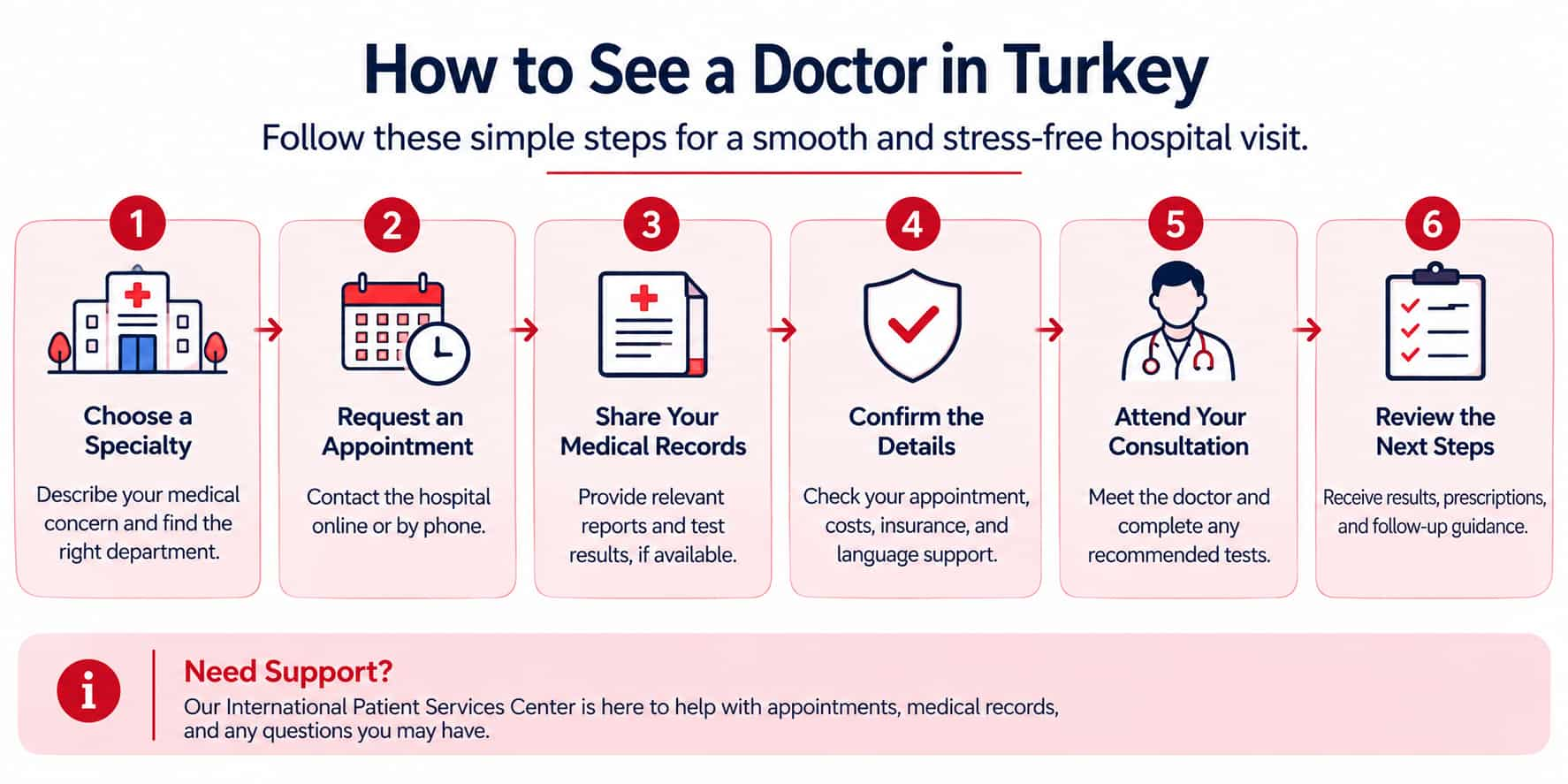
Booking With the Appointment Request Form
The appointment request form is a convenient starting point if you need help finding the right specialty or want to arrange a consultation before traveling. Provide accurate contact details and a concise explanation of why you are seeking medical care. If you already have a diagnosis or treatment recommendation, include it so your request can be directed appropriately.
You may also be asked to share relevant medical records, such as consultation notes, laboratory results, imaging reports, or pathology findings. Send only documents relevant to your request and use the hospital's designated submission channel. After receiving your request, the international patient team may contact you to clarify your needs and explain the next steps. Response times depend on the information provided, the specialty, and medical team availability.
Booking Through the International Patient Services Center
Medical Park’s International Patient Services Center helps international patients identify specialties, arrange appointments, share medical records, and understand available services before traveling to Turkey.
For current contact details and language-specific support, visit Medical Park’s International Patient Services Center page. The page provides the available contact channels for international patients, including the English-speaking team.
When contacting the team, explain whether you need a consultation, diagnostic assessment, treatment, or help with an existing medical plan. Confirm that support in your preferred language is available for your appointment and the services you require.
Remote Evaluations and Video Consultations
If you are outside Turkey, you may be able to share your medical records for an initial review before deciding whether to travel. This can help the medical team understand your diagnosis and previous treatment and determine which specialist should assess your case.
A remote review is based on the information provided and may not be sufficient to confirm a diagnosis or treatment plan. Some conditions require a physical examination, new imaging, laboratory tests, or other investigations. Before proceeding, ask which records are needed, who will review them, whether a written summary is provided, and whether a fee applies.
Same-Day and Urgent Visits
If you need to see a doctor quickly while in Turkey, contact the hospital directly and explain your symptoms and how soon you need assessment. The team can advise whether an outpatient appointment is available. Same-day appointments depend on the hospital, specialty, and doctor availability, so they should not be assumed to be guaranteed.
For severe symptoms or a possible emergency, call 112 or go to the nearest emergency department rather than waiting for a routine appointment.
What to Expect at a Medical Examination in Turkey
A medical examination usually begins with registration and a review of your medical history, followed by a consultation. Depending on your symptoms, the doctor may recommend laboratory tests, imaging, or an additional specialist assessment. The sequence and duration vary according to the medical concern and investigations required.
If you are visiting from abroad, allow enough time for the consultation and any tests that may be arranged. Not every investigation can be completed immediately, and some results require additional processing or specialist review. Tell the hospital about your travel commitments when discussing the appointment schedule.
Arrival and Registration
When you arrive, go to the registration or international patient desk and provide your passport or other accepted identification. The hospital may ask you to confirm your contact information, provide insurance details, complete registration forms, and sign consent documents before an examination or procedure. Keep your appointment confirmation accessible.
Bring important medical records and tell the registration staff if you need an interpreter. If language support has been arranged, confirm where and when you will meet the interpreter before the consultation.
The Consultation and Tests
During the consultation, the doctor will ask about your symptoms, medical history, previous diagnoses, treatments, allergies, and medications. Explain your main concerns and provide relevant reports from previous examinations or treatment abroad.
Depending on your condition, the doctor may recommend blood or urine tests, ultrasound, X-ray, CT, MRI, endoscopy, or another investigation. Not every patient needs these tests. Ask why an investigation is recommended, whether preparation is required, and when you can expect the results. Do not stop prescribed medication unless a healthcare professional instructs you to do so.
Results, Medical Reports, and Prescriptions
Once the results are available, the doctor reviews them and explains their implications for your care. You may receive a medical report summarizing the examination, findings, diagnosis where established, and recommended next steps. If you need documentation in English or another language, ask which reporting or translation options are available.
If medication is prescribed, check its name, dose, frequency, and duration with the doctor or pharmacist. Knowing the generic name can be helpful because brand names may differ between countries. Medicines are obtained from pharmacies, known locally as eczane. Outside normal opening hours, the duty pharmacy system (nöbetçi eczane) provides access to pharmacy services.
Ask hospital or accommodation staff how to find the nearest one if needed.
Follow-Up and Care After You Return Home
Before leaving the hospital, make sure you understand the next step in your care. This may involve a follow-up consultation, repeat tests, medication review, wound care, or monitoring by your doctor at home. Request copies of relevant reports and test results.
If you are returning to another country, share the medical report with your local doctor to support continuity of care. Ask the treating team whether remote follow-up is available and how to contact the hospital with questions. Remote communication can support follow-up but does not replace urgent local assessment if new or worsening symptoms develop.
Getting a Medical Second Opinion
A medical second opinion is an assessment of your diagnosis or proposed treatment by another qualified doctor. It can help clarify a complex medical situation, explain why a treatment has been recommended, or explore whether other approaches may be appropriate. Seeking another opinion does not commit you to receiving treatment at the hospital providing the review and does not replace your current doctor's care.
A second opinion is not an emergency service. If you have severe or rapidly worsening symptoms, seek immediate medical attention rather than waiting for a medical-record review.
When a Second Opinion Is Worth Seeking
You may consider a second opinion if:
- You have received a serious or complex diagnosis: Another specialist may help clarify the diagnosis and explain available treatment approaches.
- Major surgery or invasive treatment has been recommended: A further review can help you understand the reasons for the recommendation, possible alternatives, and potential risks.
- Your condition is rare or difficult to diagnose: A specialist with relevant experience may offer another perspective on your findings.
- Your symptoms continue without a clear explanation: Reviewing your history and previous results may help identify further investigations.
- Treatment has not worked as expected: Another assessment may help determine whether additional tests or a different approach should be considered.
- You have received conflicting recommendations: A second opinion can help explain why doctors may have reached different conclusions.
For more information, visit our Medical Second Opinion page.
How a Second Opinion Works Before You Travel
Medical Park provides a second-opinion request route through which international patients can submit medical information for review by an appropriate specialist. You may be asked for a summary of your symptoms, diagnosis, previous treatment, and the specific questions you want the doctor to address.
Useful documents include:
- Recent medical reports and consultation notes.
- Laboratory and pathology results.
- Imaging reports and digital image files, such as MRI, CT, or PET scans.
- Previous operation or discharge reports, if relevant.
- A current medication list and information about known allergies.
- Questions about the diagnosis or proposed treatment.
The international patient team coordinates the request and may ask for additional records. The specialist's opinion is based on the documents available, so an in-person examination or further tests may still be needed. A second opinion may confirm the original recommendation or offer a different perspective. Share the assessment with your current doctor before changing or stopping treatment.
Interpreter and Language Support
Language support can make it easier to explain symptoms, understand a diagnosis, and make informed treatment decisions. Medical Park's International Patient Services Center has a multilingual team that coordinates communication for international patients. Its published language contacts include English, Arabic, French, Russian, Albanian, Serbian, Bosnian, Croatian, Romanian, Georgian, and Bulgarian.
When booking, state your preferred language and whether you need support during the consultation, diagnostic tests, or other hospital interactions. Interpreter availability may depend on the language, hospital, appointment date, and type of service. Confirm the arrangements in advance rather than assuming an interpreter will be present at every appointment.
A professional medical interpreter can help communicate unfamiliar terminology, treatment alternatives, and potential risks more accurately. Ask whether support is available in person or remotely and whether an additional charge applies. If you would like a family member to be present, discuss this with the hospital while considering patient privacy and consent.
For language-specific contact details, visit Medical Park's Language Interpreter Services page.
Documents to Bring to a Hospital in Turkey
Preparing your documents helps the hospital register you and understand your medical history. Requirements depend on your reason for visiting, insurance arrangements, and whether you are a tourist, medical traveler, or foreign resident. Ask the hospital what it needs before your appointment.
Use this checklist as a starting point:
- Passport or accepted identification: Bring your passport and relevant entry or residence documents.
- Appointment confirmation: Keep the appointment date, time, hospital address, and department details available.
- Previous medical reports: Include consultation notes, diagnoses, discharge summaries, operation reports, and specialist letters.
- Imaging and scan files: Bring written reports and, where possible, digital images from MRI, CT, ultrasound, or X-ray examinations.
- Laboratory and pathology results: Include recent blood tests, biopsy reports, and other results relevant to your condition.
- Medication list: Record the names, doses, and frequency of your current medicines, preferably including generic names.
- Allergy information: List known medication, food, or other allergies and describe any serious previous reactions.
- Insurance documents: Bring your insurance card, policy information, pre-authorization, or guarantee letter, if applicable.
- Referral or treatment recommendation: Include letters and supporting records from the doctor who referred you or recommended a procedure.
- Children's health records: For a child's appointment, bring relevant vaccination and medical records, identification, and documents confirming parental or guardian authority where required.
If your records are not in English or Turkish, ask whether translation is needed and which documents should be translated. Keep digital and paper copies, and retain original documents whenever possible.
For a wider travel-preparation checklist, read the information on the Before Your Travel page. You can also submit an appointment request and ask which records should be sent in advance.
Health Insurance and Payment
Health insurance coverage in Turkey depends on your policy, the hospital, the treatment, and whether the service is planned or urgent. Having insurance does not automatically mean that every consultation, test, or procedure will be covered. Contact your insurer or assistance company before attending the hospital to confirm your benefits and whether approval is required.
Ask whether the hospital can bill the insurer directly or whether you must pay first and request reimbursement. These arrangements affect how much you may need to pay at the hospital.
International Health Insurance and Travel Insurance
International private health insurance may cover eligible consultations, diagnostic tests, hospital stays, or treatment abroad, subject to policy conditions. Some insurers arrange direct billing, while others require patients to pay and submit a reimbursement claim. A guarantee letter confirms that an insurer or assistance company will cover specified services, subject to its terms and approval.
Before your appointment, ask your insurer:
- Whether your policy covers medical treatment in Turkey.
- Whether the hospital and doctor are included in its network.
- Whether consultations, tests, or treatment require prior authorization.
- Whether direct billing or a guarantee letter can be arranged.
- Whether you must pay a deposit or the full amount and claim reimbursement later.
- Which reports, invoices, and payment documents are needed for a claim.
Travel insurance primarily covers unexpected events during a trip. Planned treatment, pre-existing conditions, and routine check-ups may be excluded or subject to specific conditions. Read your policy and contact the insurer before arranging non-emergency care.
Medical Park's International Patient Services Center can coordinate communication with relevant insurance or international assistance organizations and explain the arrangements available for your case. However, coverage and payment approval are determined by the insurer and policy terms.
Paying Without Insurance
You can receive medical care as a self-paying patient if you do not have insurance or your policy does not cover the service. For planned treatment, a cost estimate can be prepared after the medical team reviews your records and considers the proposed evaluation or treatment plan. The estimate may change if an in-person examination or additional tests identify further medical needs.
Ask what the estimate includes and whether separate charges may apply for consultations, tests, medication, hospital stays, anesthesia, or follow-up appointments. Clarify accepted payment methods, whether an advance payment is required, and when the remaining balance is due. Request written information about the proposed services and charges.
Foreign Residents and Turkish Health Insurance
Foreign residents may have different healthcare access and insurance options from short-term visitors. Eligibility for public health insurance can depend on residence status, length of residence, employment, and other legal requirements. Private health insurance may also be available, depending on the policy.
If you live in Turkey, check your eligibility and obligations with the relevant Turkish authorities or your insurer. Bring your residence identification and current insurance documents when arranging an appointment.
If You Get Sick While Traveling in Turkey
The right place to seek help depends on the severity of your symptoms. For a serious or potentially life-threatening condition, call 112 or go to the nearest emergency department. For a stable, non-emergency concern, contact a hospital to ask about an outpatient appointment.
If you receive medical care while traveling, keep copies of consultation notes, prescriptions, test results, and itemized receipts. Your travel insurer may need these documents to assess a claim. Contact the insurer or its assistance service promptly, particularly if you are admitted to hospital, but do not delay emergency care while seeking approval.
If you take regular prescription medication, bring enough for your planned stay, preferably in its original packaging. Carry a copy of the prescription and, where appropriate, a doctor's letter explaining why you need the medicine. Rules for bringing medicines across borders vary, particularly for controlled or restricted medications, so check official guidance before traveling. If you need a prescription in Turkey, arrange a medical assessment and show the doctor your existing prescription and the medicine's generic name.
Choosing a Hospital, Specialty, and Doctor in Turkey
Choosing a hospital involves more than comparing locations or appointment availability. The hospital should provide the specialty and diagnostic services relevant to your condition, explain how your care will be coordinated, and communicate clearly about medical and financial arrangements.
When comparing hospitals, consider the following:
- Relevant specialty and clinical services: Check whether the hospital has a department or specialist team that evaluates and treats your condition. For complex conditions, ask whether related specialties can be involved.
- Doctor's qualifications and experience: Review the doctor's education, specialty, and experience with the condition or procedure you are considering. Ask who will be responsible for your care.
- Hospital facilities: Confirm that the relevant laboratory, imaging, operating room, or other specialist facilities are available at the hospital.
- Accreditation and quality information: Look for current, verifiable accreditation. Accreditation applies to specific institutions and should not be assumed to cover every hospital in a group.
- Language and patient coordination: Ask whether an interpreter can be arranged and who will coordinate appointments, records, and follow-up.
- Location and access: Consider the distance between the hospital, your accommodation, and the airport, especially if you need repeated visits.
- Clear cost information: Request an estimate and clarify what it includes, which services may be billed separately, and how insurance approval is handled.
A hospital's website can help you compare departments, doctors, and facilities, but it does not replace a discussion about your individual medical needs. If you are unsure which hospital or specialty is appropriate, contact the international patient team with a short summary of your condition.
Finding the Right Specialty
The correct specialty depends on your symptoms, medical history, and any diagnosis you already have. A heart-related concern may require Cardiology, persistent digestive symptoms may be assessed by Gastroenterology, and a joint injury may require Orthopedics and Traumatology. Dermatology evaluates conditions affecting the skin, hair, and nails.
Some symptoms can involve more than one specialty. If you have received a diagnosis or recommendation, share the relevant report when requesting an appointment. If you do not know which department to contact, explain your symptoms and previous investigations to the International Patient Services Center so the team can help direct your request. The treating medical team determines the appropriate clinical assessment.
Hospital, Specialty, and Doctor Profiles
Hospital profiles help you review a facility's location, services, and departments. Specialty pages explain the conditions assessed and the diagnostic or treatment services provided, while doctor profiles provide information about a physician's specialty, professional background, and clinical interests.
Consider these pages together rather than choosing a doctor based on a single detail. If you are considering a complex procedure, ask which specialist will assess you, who will perform the procedure if recommended, and how follow-up will be arranged.
Where Medical Park Hospitals Are Located
Medical Park operates hospitals in several cities in Turkey, including Istanbul and other major urban centers. The most suitable location depends on the specialty, services required, appointment availability, and your travel plans. If you need several consultations or tests, coordinating them at the same hospital may be practical.
Check our Hospitals page to compare locations and departments. If you are unsure which facility provides the service you need, the International Patient Services Center can help direct your request.
Check-Ups and Preventive Screening in Turkey
A medical check-up can review your general health, identify risk factors, and determine whether further assessment or preventive care is appropriate. The recommended tests depend on factors such as age, sex, family history, lifestyle, existing conditions, and previous results.
A full body check-up should be tailored to the individual rather than based on the assumption that more tests are always better. Some investigations are useful only for people with particular symptoms or risk factors, and unnecessary testing can lead to false alarms or additional procedures. Discuss your health history and goals with the doctor so the assessment is appropriate.
Before booking, ask which consultations and tests are included, whether fasting or other preparation is required, how long the assessment may take, and when results will be available. If you are traveling specifically for a check-up, allow enough time for the doctor to review the findings and explain whether follow-up is needed.
For more information, read our dedicated guide to full body check-up in Turkey.
Planning Your Trip Around Your Appointment
If you are traveling to Turkey for medical care, confirm the hospital, doctor, appointment date, and expected schedule before booking flights or accommodation. The medical team may need to review your records before advising how long you should stay. Additional tests or consultations may affect the schedule, so avoid arranging a return flight that leaves no room for changes.
Check the visa and entry requirements that apply to your nationality through official Turkish government channels. If you need a hospital invitation letter for a visa application, ask the International Patient Services Center whether one can be provided. An invitation letter does not guarantee that a visa will be issued; the relevant authorities make that decision.
Consider how you will travel between the airport, accommodation, and hospital. Medical Park's international patient team can provide guidance on available transfer coordination and accommodation options. If you are traveling with a companion or may need assistance after a procedure, discuss this before arrival.
Bring enough of your regular medication for the trip, together with the prescription and a doctor's letter where appropriate. Check the rules for bringing medicines into Turkey, particularly if they contain controlled substances. Keep a record of each medicine's generic name and prescribed dose, as brand names and availability may differ between countries.
If you are having surgery, an invasive procedure, sedation, or a test that may affect your ability to fly, ask the treating doctor when it is safe to travel. The recommended interval depends on the procedure, your recovery, and your individual health.
Before Your Hospital Appointment in Turkey: A Checklist
A little preparation can make your hospital visit easier, particularly if you are traveling to Turkey or visiting a hospital for the first time. Use this checklist to organize the information and documents you may need.
Confirm your appointment: Check the date, time, hospital location, department, and doctor's name.
Prepare your identification: Bring your passport or accepted identification and relevant residence documents, if applicable.
Gather medical records: Collect previous diagnoses, consultation notes, discharge summaries, operation reports, and treatment recommendations.
Bring test results: Prepare relevant laboratory results, pathology reports, and imaging reports or digital scan files.
List your medications: Write down the names, doses, and frequency of your current medicines.
Record allergies: Note any known medication or other allergies and previous serious reactions.
Check insurance requirements: Bring your insurance details and confirm whether prior authorization or a guarantee letter is needed.
Arrange language support: Inform the hospital if you need an interpreter and confirm availability before your visit.
Prepare your questions: Write down your symptoms, concerns, and questions about diagnosis, tests, treatment, or costs.
Confirm practical arrangements: If you are traveling for treatment, check transportation, accommodation, and any preparation instructions provided by the hospital.
Requirements may vary depending on the hospital, your medical needs, and the type of appointment. Contact the hospital in advance if you are unsure which documents or preparations are necessary.
International Patient Services and Appointment Support at Medical Park
Medical Park's hospitals provide consultations, diagnostic services, and treatment across a range of medical specialties. International patients can contact the International Patient Services Center to explain their medical needs, share available records, and request coordination with an appropriate hospital or specialist. For planned treatment, the team can help arrange an initial review of medical information and explain whether an in-person examination or further tests may be needed.
The International Patient Services Center supports appointment scheduling, communication with medical teams, medical-record coordination, and requests for a medical second opinion. It can also provide guidance on interpreter support, visa invitation letters, airport and hospital transfers, and accommodation options. The exact arrangements depend on the patient's needs, the hospital, and the services available.




 Makaleye Dön
 E-Result
 WhatsApp