


 TR
 EN
 RU
 AR
 FR


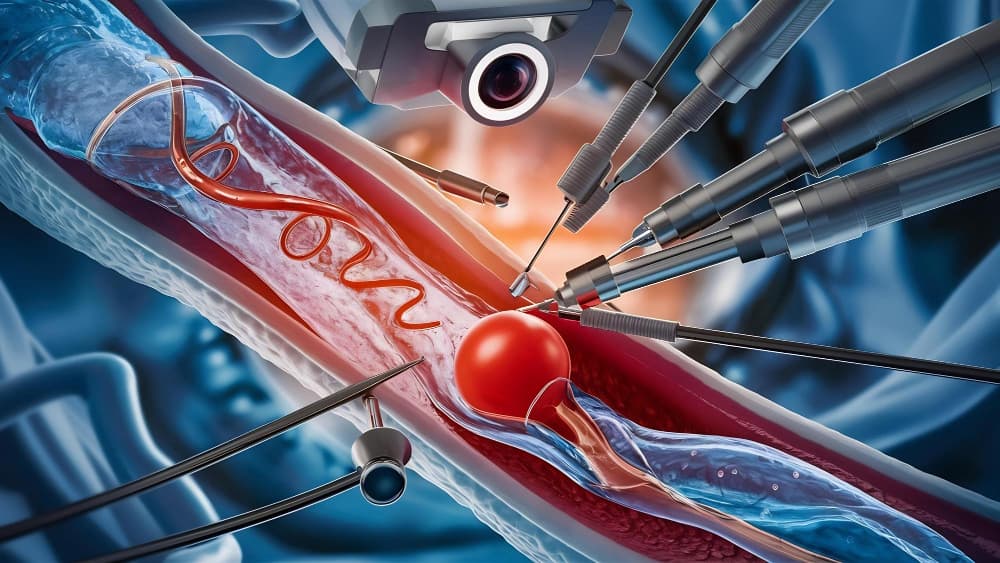

Carotid artery stenting is a minimally invasive procedure that widens a narrowed carotid artery using a catheter-delivered stent, restoring normal blood flow to the brain without open surgery. As an alternative to carotid endarterectomy, it offers patients at higher surgical risk a way to treat carotid artery stenosis and reduce stroke risk through the blood vessels themselves rather than through a neck incision.
What Is Carotid Artery Stenting?
Carotid artery stenting is an endovascular procedure that opens a narrowed carotid artery from the inside, using the same family of techniques as coronary angioplasty — the catheter-based treatment used to open blocked heart arteries. A specialist guides a thin catheter through the blood vessels to the site of the narrowing in the neck, inflates a small balloon to widen the artery, and deploys a stent — a flexible mesh tube — to hold the vessel open permanently. Unlike carotid endarterectomy, which physically removes plaque through a surgical incision, stenting works by compressing the plaque against the artery wall and supporting the vessel from within.
This procedure exists because not every patient is a good candidate for open surgery. Patients with difficult neck anatomy, a history of neck radiation or previous surgery, significant heart or lung disease, or other factors that raise surgical risk may be better served by an approach that avoids general anesthesia and a surgical incision altogether.
How Carotid Artery Stenting Works
The procedure is built around three core steps: gaining access to the arterial system, protecting the brain from debris during the intervention, and placing the stent itself. The access route chosen has a meaningful effect on both safety and recovery.
Access Routes
Transfemoral Approach: This traditional method involves introducing the catheter through the femoral artery in the groin and advancing it upward through the aorta into the neck. While it provides a long, well-established path to the carotid artery, it requires navigating the aortic arch, where scraping against plaque in older or higher-risk patients can itself become a source of embolic complications.
Transradial Approach: This more recent technique accesses the arterial system through the radial artery in the wrist instead of the groin. This modern pathway is associated with fewer access-site complications, faster mobilization after the procedure, and a shorter recovery at the puncture site, though it is technically more demanding and not suitable for every patient's vascular anatomy.
Transcarotid Artery Revascularization (TCAR): This advanced hybrid technique accesses the carotid artery directly through a small incision at the base of the neck, completely bypassing the aortic arch. It uses a specialized flow-reversal system to protect the brain from loose plaque debris throughout the intervention, combining the advantages of both open surgical protection and minimally invasive endovascular approaches.
Embolic Protection
One of the central safety challenges in carotid artery stenting is preventing small fragments of plaque from breaking loose and traveling to the brain, where they could cause a stroke. To address this, an embolic protection device is used in nearly all modern procedures. The most common type is a distal filter — a small umbrella-like mesh device deployed beyond the narrowed segment before the stent is placed, which catches debris dislodged during balloon inflation and stent deployment, and is removed once the procedure is complete. Proximal protection systems, used in TCAR and some transfemoral procedures, work by temporarily reversing or stopping blood flow through the artery during the critical phase of the intervention, so that any debris flows away from the brain rather than toward it.
Stent Deployment
Once embolic protection is in place, the specialist crosses the narrowed segment with a guidewire and often performs a brief balloon angioplasty to pre-dilate the vessel. A self-expanding stent is then advanced over the wire and deployed across the narrowed segment, where it expands against the arterial wall and compresses the plaque, restoring a wide channel for blood flow. A final balloon inflation inside the stent, called post-dilation, ensures the stent is fully apposed against the vessel wall. The embolic protection device is then retrieved, and a final angiogram confirms that blood flow has been restored to normal.

Who Is a Candidate for Carotid Artery Stenting?
Carotid artery stenting is considered for patients with significant carotid artery stenosis — generally 70 percent or greater in asymptomatic patients, or 50 percent or greater in patients who have already had a transient ischemic attack (mini-stroke) or cerebrovascular accident (stroke) — who are also at elevated risk from open surgery. Factors that typically favor stenting over carotid endarterectomy include:
- High surgical risk due to pulmonary or cardiovascular disease: Patients with significant heart failure, recent heart attack, or severe lung disease may not tolerate general anesthesia well, making a procedure under local anesthesia preferable
- Difficult surgical anatomy: A carotid bifurcation positioned high in the neck, previous neck surgery or radiation, or a short, thick neck can make surgical access challenging and increase the risk of nerve injury during an open operation
- Restenosis after previous carotid endarterectomy: Scar tissue from a prior surgery makes a second operation technically more difficult, and stenting offers an effective alternative for treating a re-narrowed artery
- Patient preference for a less invasive approach: Some patients prefer to avoid a neck incision and the longer recovery associated with open surgery, particularly when their anatomy and risk profile make stenting an equally effective option
The choice between carotid artery stenting and carotid endarterectomy is always made individually, weighing anatomical suitability, surgical risk, and the latest clinical evidence comparing outcomes between the two approaches.
Carotid Artery Stenting vs Carotid Endarterectomy
Both procedures aim to achieve the same outcome — reopening a narrowed carotid artery to reduce stroke risk — but they differ meaningfully in approach, recovery, and the specific risks involved. Carotid endarterectomy has the longer track record and the most extensive clinical trial evidence, particularly in patients under 70 with straightforward surgical anatomy. Carotid artery stenting has closed much of that evidence gap in appropriately selected patients, particularly those at high surgical risk, and large comparative trials have shown broadly similar long-term outcomes between the two approaches when patients are matched appropriately.
The most consistent difference in the research is the pattern of complications: carotid artery stenting carries a slightly higher risk of stroke around the time of the procedure, primarily minor strokes related to embolic debris, while carotid endarterectomy carries a higher risk of heart attack in the perioperative period, related to the cardiovascular stress of surgery and anesthesia. This trade-off is one of the key factors specialists weigh when recommending one approach over the other, alongside the patient's age, since outcomes data has shown a relative advantage for surgery in older patients and a relative advantage for stenting in younger patients.
Diagnosis Before Treatment
Before either procedure is performed, the degree of stenosis and the character of the carotid plaque must be established through imaging. Carotid ultrasound, also called carotid duplex imaging, is the standard first-line investigation, using sound waves to measure the severity of narrowing and assess blood flow velocity without any radiation or invasive testing.
Where the findings require confirmation, or detailed mapping of the artery is needed to plan the stenting procedure, CT angiography or MR angiography provides a more complete three-dimensional picture of the carotid and cerebral vasculature, including the anatomy of the aortic arch, which has a direct bearing on which access route is most appropriate.
Recovery Time for Carotid Artery Stenting
One of the most significant advantages of carotid artery stenting over open surgery is the recovery period. Most patients are observed overnight in hospital following the procedure and are discharged within 24 to 48 hours, considerably sooner than the typical recovery after carotid endarterectomy. Because there is no surgical incision in the neck, there is no wound to heal and no risk of nerve injury to the structures that run close to the carotid artery, which can affect voice or swallowing after open surgery.
Patients are typically able to resume light activity within a few days and most normal activities within one to two weeks, depending on which access route was used. Transradial and transcarotid approaches tend to allow faster mobilization than the traditional transfemoral route, where a period of lying flat is often required to allow the groin puncture site to heal securely.
Follow-up carotid ultrasound is performed at intervals after the procedure — typically at one month, six months, and annually thereafter — to confirm the stent remains open and monitor for restenosis.
Antiplatelet Medicine After Stenting
Dual antiplatelet therapy — typically aspirin combined with clopidogrel — is a critical part of treatment both before and after carotid artery stenting. These medications reduce the stickiness of blood platelets and prevent a clot from forming on the surface of the newly placed stent while the body's own lining cells grow over it, a process called endothelialization that typically takes several weeks.
Most patients continue dual antiplatelet therapy for one to three months, after which they are transitioned to long-term single antiplatelet therapy, continued indefinitely alongside the same vascular risk factor management — blood pressure control, statin therapy, and smoking cessation — used for all patients with carotid atherosclerosis.
Carotid Artery Stenting Risks
Like any vascular procedure, carotid artery stenting carries risks that are weighed carefully against the benefit of treating the stenosis. The most important risks include:
- Stroke during or shortly after the procedure: The most serious risk, occurring in a small percentage of cases, usually related to embolic debris dislodged during balloon angioplasty or stent deployment despite embolic protection
- Access site complications: Bruising, bleeding, or, rarely, injury to the artery at the groin, wrist, or neck puncture site
- Restenosis: Re-narrowing of the treated artery over time, monitored through follow-up ultrasound and occasionally requiring repeat treatment
- Stent thrombosis: Clot formation on the stent itself, which is why dual antiplatelet therapy is followed strictly in the weeks after the procedure
- Contrast-related complications: A small risk of allergic reaction to the contrast dye used during imaging, or temporary kidney strain, particularly in patients with pre-existing kidney impairment
Stroke Prevention and Carotid Artery Disease Treatment at Medical Park
Medical Park Hospitals in Turkey offer both carotid artery stenting and carotid endarterectomy through a collaborative team of cardiologists, cardiovascular surgeons, and interventional radiologists who work in close coordination with our dedicated Stroke Center. This specialized center ensures comprehensive stroke risk assessment, personalized treatment plans, meticulous monitoring before and after the procedure, and immediate access to acute stroke treatment when needed.
Carotid stenting is performed by specialists experienced in transfemoral and transradial access, with embolic protection used routinely and dual antiplatelet therapy managed according to current evidence-based protocols. Carotid ultrasound, CT angiography, and MR angiography are available within the same diagnostic pathway, allowing stenosis severity and aortic arch anatomy to be fully assessed before a treatment recommendation is made.
International patients who have been advised to undergo carotid artery stenting or carotid endarterectomy elsewhere and want an independent second opinion on which approach best fits their anatomy and risk profile can arrange a comprehensive clinical review through Medical Park's international patient services team. This care pathway provides comprehensive follow-up, post-procedure monitoring, and long-term secondary prevention within a single integrated hospital system.








 Makaleye Dön
 E-Result
 WhatsApp